
Udhar Band Hai Posters: Free to Download and Print
Free “udhar band hai” posters in six languages, credit rules posters you can fill in, and polite words to use when a customer still asks for udhar.
Quick answer
Udhar band hai means “credit is closed”: the shop no longer sells on credit, so customers pay when they buy. In English the sign says No credit. In Urdu it is written ادھار بند ہے and in Hindi उधार बंद है. Below you can download free posters in Urdu, Roman Urdu, Hindi, English, Pashto and Dari, as a PNG for WhatsApp or an A4 PDF for printing, plus fill-in posters for shops that still give udhar with a limit.
Key takeaways
- A poster starts the conversation; you still need a polite line to say at the counter.
- Say no the same way to everyone, so no customer feels singled out.
- If you cannot stop udhar completely, set a limit and a repayment day, and write every entry down.
- Never put up the names of customers who owe you money.
Download free udhar band hai posters
All posters are free. Print them for your shop, put them on your WhatsApp status or share them with other shopkeepers; you do not need to sign up. Each poster comes as a PNG (1588 × 2246 pixels, for phones and quick printing) and an A4 PDF (the sharpest print at any size). Tap a poster to see it full size.
“No credit” posters
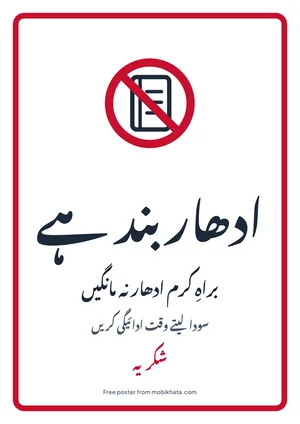
Urdu
ادھار بند ہے
براہِ کرم ادھار نہ مانگیں
Roman Urdu
Udhar band hai
Meherbani karke udhar na mangein
English
No credit
Please do not ask for credit
Hindi
उधार बंद है
कृपया उधार न माँगें
Pashto
پور بند دی
مهرباني وکړئ پور مه غواړئ
Dari
نسیه بند است
لطفاً نسیه طلب نکنید
Aaj naqad, kal udhar
آج نقد، کل ادھار
आज नकद, कल उधार


Credit rules posters: fill in your own limit
For shops that still give udhar to regular customers. Write your limit and repayment day in the blank spaces with a marker before you put the poster up.
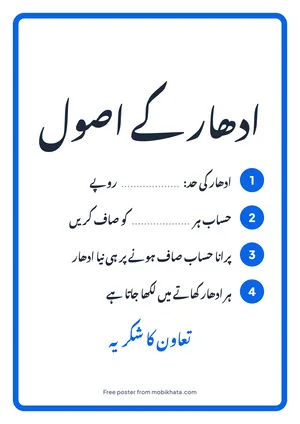
Urdu
ادھار کے اصول
Limit and repayment day
Roman Urdu
Udhar ke usool
Limit and repayment day
English
Our credit rules
Limit and repayment day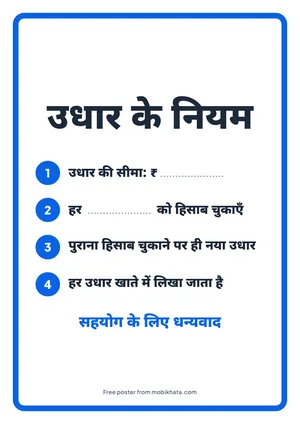
Hindi
उधार के नियम
Limit and repayment day


Download all 11 posters in one PDF
What does “udhar band hai” mean in English?
Udhar (also written udhaar or udaar) means goods or money given now and paid for later. Band hai means “is closed”. So udhar band hai means the shop has stopped giving credit: no credit, or credit is closed. Shopkeepers also write udhar mana hai (credit is not allowed) or yahan udhar nahi milta (no credit is given here). This is how the same sign is written in other languages:
| Language | How to write it | Notes |
|---|---|---|
| English | No credit | Also “Credit closed” or “Please do not ask for credit” |
| Urdu | ادھار بند ہے | “Udhar mana hai” is ادھار منع ہے |
| Roman Urdu | Udhar band hai | Common on printed signs and WhatsApp |
| Hindi | उधार बंद है | Also उधार मना है |
| Punjabi (Shahmukhi) | ادھار بند اے | Used in Pakistani Punjab |
| Punjabi (Gurmukhi) | ਉਧਾਰ ਬੰਦ ਹੈ | Used in Indian Punjab |
| Gujarati | ઉધાર બંધ છે | Read “udhar bandh chhe” |
| Marathi | उधारी बंद आहे | Read “udhari band aahe” |
| Bengali | বাকি বন্ধ | “Baki” is the Bengali word for credit |
| Pashto | پور بند دی | “Por” means credit or a loan |
| Dari | نسیه بند است | Some shops write قرض instead of نسیه |
Which poster should you use?
Pick the language your customers read most easily. In most Pakistani shops that means Urdu, or Roman Urdu for younger customers. In India it is usually Hindi, and in Afghanistan Dari or Pashto. In a mixed area, print two and put them side by side.
- Stopping udhar completely: use a “No credit” poster in your customers’ language.
- Still giving udhar to some customers: use a credit rules poster with your limit and repayment day filled in. Everyone sees the rules before they ask, so you are not refusing a person, only following the sign.
- Want a lighter tone: “Aaj naqad, kal udhar” (cash today, credit tomorrow) is an old shop saying that makes customers smile. Tomorrow never comes, so the message is clear without sounding harsh.
How to print and put up your poster
- Print the PDF on A4 paper. Any printer will do. The posters are mostly white, so they use little ink and read clearly in black and white.
- Need it bigger? Ask a print or photocopy shop to print the PDF on A3. It stays sharp at any size.
- Protect it. Lamination or a plastic sleeve keeps it clean near flour, oil and dust.
- Put it where money changes hands: at eye level behind the counter, next to the galla or the scale. In a busy shop, put a second copy at the entrance.
- Share the PNG first. Put it on your WhatsApp status a day before the poster goes up, so regular customers hear it from you and not from the wall.
How to say no to udhar politely
A poster does half the work. The other half is what you say when a customer asks anyway. Keep it calm and short, and use the same words for everyone. These lines are in Roman Urdu, with their meaning in English:
| What to say | Meaning | When to use it |
|---|---|---|
| “Maaf kijiye, humne udhar band kar diya hai. Aap cash ya mobile se payment kar sakte hain.” | Sorry, we have stopped giving credit. You can pay by cash or mobile. | The first time a customer asks after the poster goes up |
| “Yeh rule sab ke liye hai, sirf aap ke liye nahi.” | This rule is for everyone, not just you. | When a regular customer feels hurt |
| “Pehle purana hisab saaf kar dein, phir naya saman le jayein.” | Clear your old balance first, then take new goods. | Customers who already owe you |
| “Aaj jitne paise hain, utna saman le jayein. Baqi main kal ke liye rakh deta hoon.” | Take what you can pay for today. I will keep the rest for you until tomorrow. | When someone is short of money for a full purchase |
| “Aap ki udhar ki had poori ho gayi hai. Hisab kam ho jaye to phir baat karte hain.” | You have reached your credit limit. Once your balance comes down, we can talk again. | Shops that set a credit limit |
| “Malik ne udhar band kiya hai, main kuch nahi kar sakta.” | The owner has stopped credit; I cannot change that. | Shop staff, so customers do not pressure them |
| “Aap hamare purane gahak hain. Samajhne ka shukriya.” | You are one of our old customers. Thank you for understanding. | To end the conversation warmly |
Three habits make these lines work:
- Do not make exceptions in front of others. If one customer gets udhar at the counter, the next one will ask too.
- Do not argue about old balances. If a customer disputes what they owe, show the dated entries instead of raising your voice.
- Talk to your biggest regular customers privately before the poster goes up. Two minutes of talk now saves an argument at the counter later.
If you still give udhar, set clear rules
Many shops cannot stop udhar completely. Salaried customers buy on credit until payday and farmers until harvest, and a shop that refuses everyone can lose them to the shop next door. The answer is udhar with rules that every customer knows:
- A limit for each customer: no more than they can pay back from one salary or one week’s earnings.
- A repayment day: payday, every Saturday or the first of the month. Write it next to the customer’s name.
- Old balance first: no new udhar until the last balance is paid, or at least brought down.
- Regular customers only: new customers pay at the time of purchase until you know them.
- Write every entry at once, with the date and the items, and tell the customer their new total.
Here is how a karyana store might set its limits. These numbers are only an example; choose ones that fit your shop and your customers:
| Customer | Limit | Pays back |
|---|---|---|
| Salaried family buying the monthly ration | Rs. 15,000 | On salary day each month |
| Daily-wage worker | Rs. 2,000 | Every Saturday |
| Nearby hotel or tea stall buying in bulk | Rs. 25,000 | Every 15 days |
| New customer | No udhar | Cash or mobile payment only |
If old udhar is already a problem, our guide Udhar Wapas Kaise Le? 10 Polite Ways to Recover Udhar covers getting it back without losing the customer.
Short lines for your shop or WhatsApp status
Many shopkeepers look for udhar quotes or udhar shayari for their shop. Old signs such as “Udhar prem ki kainchi hai” (credit is the scissors that cut love) are still popular. Here are some new lines, written for this page, that you are free to use:
- “Udhar band, muskurahat jaari.” Credit has stopped; the smiles have not.
- “Hum aap par bharosa karte hain, bas udhar par nahi.” We trust you, just not on credit.
- “Aaj ka saman, aaj ka hisab.” Today’s goods, today’s payment.
- “Purana hisab saaf, naya saman haazir.” Clear the old balance, and new goods are ready.
- “Udhar se rishte kamzor hote hain, nakad se mazboot.” Credit weakens relationships; cash keeps them strong.
Will a poster upset your customers?
Some customers may grumble for a few days. Most understand, because the rule is the same for everyone and they have seen the same sign in other shops. What upsets people is being refused in front of others, or a sign that insults them. Avoid these:
- Never put up the names of people who owe you money. It shames them in public and can get you into legal trouble. Remind them privately instead.
- Avoid angry or insulting lines, such as signs that call anyone who asks for udhar dishonest. Your good customers read them too.
- Do not demand every old balance at once. A new poster is about new udhar. Agree a date with each customer who already owes you.
For polite messages to send before and after the due date, see our payment reminder messages in English, Roman Urdu, Urdu, Pashto and Dari.
Where MobiKhata helps
A poster stops new udhar, but you still need to collect what customers already owe, and to track the udhar you keep giving to trusted customers. MobiKhata does this on your phone, for free. Add each customer as a party, record udhar given as Cash Out and payments received as Cash In, and the app shows what each customer owes. You can send a customer their balance or a PDF statement on WhatsApp or by SMS, and on Android you can schedule balance reminders. MobiKhata does not set or enforce a credit limit, so check a customer’s balance before giving more.
Still giving udhar to a few customers?
Record every udhar in MobiKhata and see who owes you at a glance. Free, with no ads, in 8 languages including Urdu, Pashto and Dari.


On a computer? Use the same account in the MobiKhata web app.
Frequently asked questions
What does “udhar band hai” mean in English?
“Udhar band hai” means “credit is closed”, or simply “no credit”. A shop with this sign does not sell on credit, so you pay at the time of purchase.
How do you write udhar band hai in Urdu?
In Urdu it is written ادھار بند ہے. A fuller poster adds براہِ کرم ادھار نہ مانگیں, which means “please do not ask for credit”, and شکریہ, “thank you”.
What does “aaj naqad, kal udhar” mean?
It means “cash today, credit tomorrow”. It is an old shop saying: tomorrow never comes, so the shop is politely saying that it does not give credit.
Are these udhar band hai posters free?
Yes. You can print them, use them in your shop and share them on WhatsApp for free, without signing up. Please do not sell them.
What size should I print an udhar band hai poster?
The PDF is A4, which suits most shop counters. For a bigger poster, ask a print shop to print the PDF on A3; it stays sharp at any size. Use the PNG for WhatsApp status and sharing on phones.
How can I refuse udhar without losing customers?
Use the same calm words for everyone, never refuse a customer in front of others, offer a smaller purchase they can pay for today, and tell your biggest regular customers yourself before the poster goes up.
Should I stop giving udhar completely?
Not always. If many of your customers are paid monthly or at harvest, credit with rules works better: a limit for each customer, a fixed repayment day, no new udhar until the old balance is paid, and every entry written down.
Related reading
- Udhar Wapas Kaise Le? 10 Polite Ways to Recover Udhar
- Payment Reminder Messages: 20 Polite Udhaar Templates
- How to Manage Udaar Without Losing Money
- Dukan Ka Hisab Kaise Rakhe? A Simple System for Shops
- Udaar Book App: How to Choose the Best Digital Udaar Book
Keep track of the udhar you still give
Record udhar and payments, see every balance and send statements on WhatsApp. Free on Android and iPhone.
Free on Android and iPhone. Also on the web.